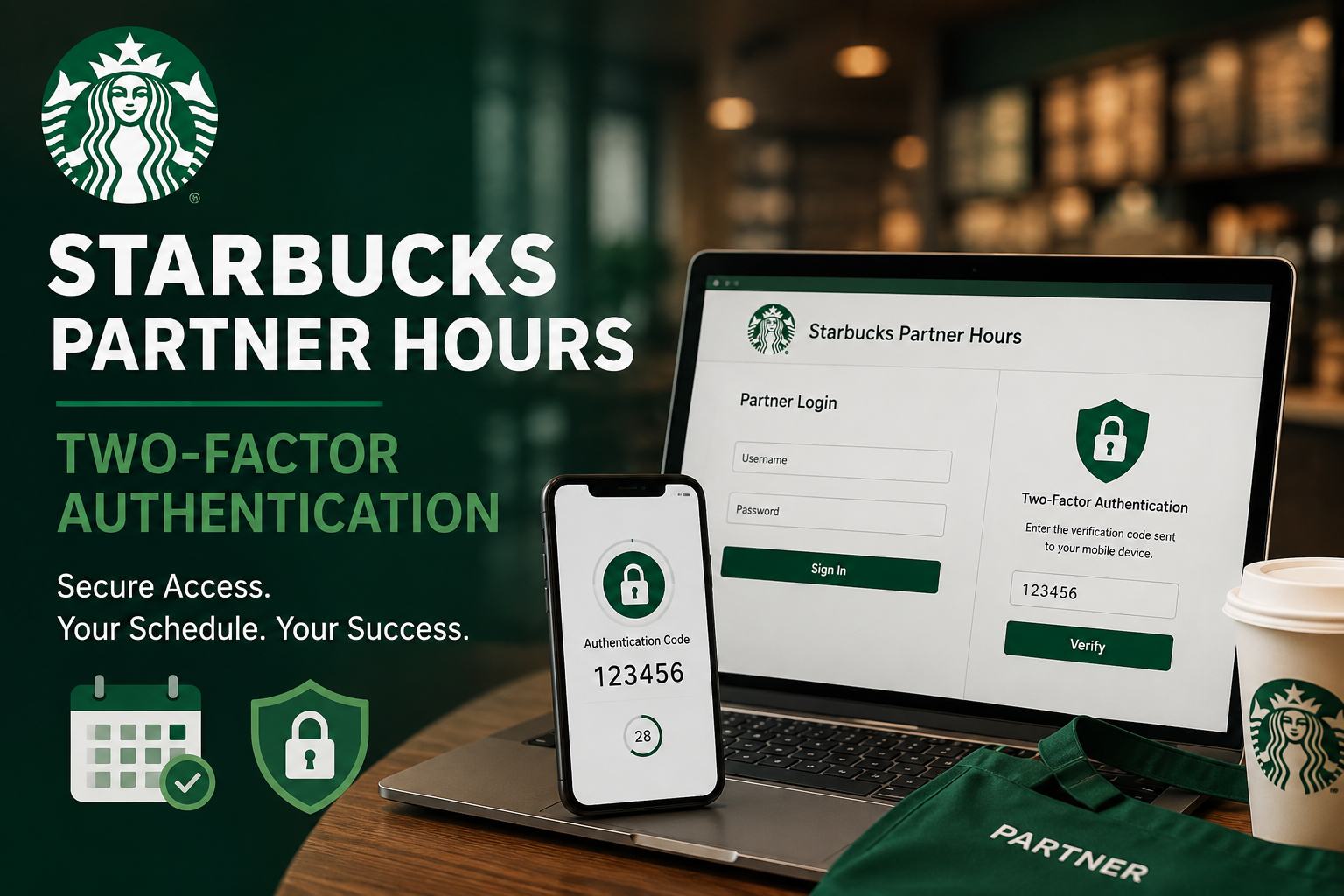
For Starbucks employees, commonly known as partners, having easy access to work schedules and secure employee systems is an important part of managing day-to-day work. Starbucks Partner Hours is designed to help partners view and manage their work schedules, while two-factor authentication (2FA) adds an additional layer of security when accessing company systems.
Understanding how Partner Hours works and why two-factor authentication may be required can make the login process much easier. This article explains Starbucks Partner Hours, the role of authentication, common login challenges, and practical security tips for partners.
What Is Starbucks Partner Hours?
Starbucks Partner Hours is a workforce scheduling system that allows eligible partners to access information related to their work schedules. Instead of relying entirely on printed schedules or asking a store leader about upcoming shifts, partners can use digital tools to check their assigned hours and other scheduling information.
Starbucks has continued to invest in scheduling technology as part of its broader effort to give partners more stability and consistency. The company has said that its scheduling approach considers both store requirements and partner preferences, with schedules generally established in advance while allowing adjustments when circumstances require them.
This makes digital scheduling particularly useful for employees who need to check when they are working, plan personal commitments, or keep track of changes to their shifts.
Why Partner Hours Is Important
A work schedule is more than a list of shifts. It affects transportation, family commitments, school, personal appointments, and income planning. Having digital access to scheduling information gives employees greater visibility and flexibility.
Starbucks has reported that its partner-focused scheduling efforts have increased the number of partners receiving preferred schedules. In 2026, the company reported that nearly 95% of partners were receiving their preferred schedules and that more partners were working the hours they wanted.
For this reason, being able to access Partner Hours reliably is valuable. A partner may want to check a shift before leaving home, confirm a schedule change, or review upcoming working hours.
What Is Two-Factor Authentication?
Two-factor authentication, often called 2FA or multi-factor authentication (MFA), is a security method that requires more than one form of verification before an account can be accessed.
A traditional login normally requires a username and password. With 2FA, the system may require an additional verification method, such as a code sent to a registered phone number, an authentication-app notification, or a time-based one-time password.
The basic idea is simple: even if someone discovers a user’s password, they may still be unable to access the account without the second authentication factor.
Starbucks-related authentication documentation describes several MFA methods, including email codes, SMS codes, voice codes, push notifications, time-based one-time passwords, and supported device authentication.
Why Does Starbucks Use Two-Factor Authentication?
Employee accounts can provide access to information and systems that should not be available to unauthorized individuals. Strong authentication helps protect these accounts from common threats such as stolen passwords, phishing, and unauthorized logins.
Two-factor authentication is especially useful because passwords can sometimes be compromised. An employee might accidentally enter credentials on a fake website, reuse a password on another service, or have a password exposed through a security incident.
With an additional authentication step, the attacker would generally need access to the second factor as well. This does not make an account completely immune to attacks, but it significantly improves account security.
For partners, this means that an additional authentication request during the login process should not automatically be viewed as an error. It may simply be part of the security system protecting the account.
How Two-Factor Authentication Works
The exact login process can vary depending on the Starbucks system, account configuration, device, and authentication method. Generally, the process follows a simple sequence.
First, the partner enters the required username or account identifier. The system then requests the password or another primary credential. If multi-factor authentication is enabled, the system asks for an additional verification method.
For example, the second step could involve receiving a temporary code through an approved method. The partner enters that code into the authentication screen. If the verification succeeds, access is granted.
Some systems can also use authentication applications that generate time-based codes or send push notifications. Starbucks authentication documentation specifically describes push authentication and TOTP, or time-based one-time passwords, as available MFA approaches in its documented environment.
Common Partner Hours Login Problems
Partners may occasionally experience difficulties when attempting to access scheduling systems. A problem does not necessarily mean that the account is disabled.
One common issue is an authentication failure. This can happen when a verification code expires, the wrong code is entered, or the authentication method is not properly configured.
Another possibility is a device or application problem. Employees who change phones, reinstall applications, or change device settings may need to complete authentication or device enrollment again.
There can also be differences between Starbucks systems. A login used for one Starbucks service may not necessarily work exactly the same way for another. Starbucks has noted that some internal systems can have credentials that differ from other enterprise credentials.
If a partner encounters a persistent login problem, the safest approach is to use official Starbucks support channels or contact a store leader rather than relying on unofficial websites or strangers asking for login information.
Security Tips for Starbucks Partners
Partners can take several simple steps to protect their accounts.
First, protect your password. Never share your password with coworkers, friends, or anyone who claims to need it for troubleshooting.
Second, protect your second factor. A verification code should be treated as confidential. If someone asks you to send them an authentication code, do not provide it.
Third, be careful with links. Phishing messages can imitate legitimate employee portals and attempt to steal usernames and passwords. Before entering credentials, make sure you are using an authorized Starbucks resource.
Fourth, secure your phone. If authentication depends on a mobile device, use the device’s security features, such as a screen lock or biometric protection.
Finally, report suspicious activity. If you believe someone has accessed your account or you accidentally provided credentials to a suspicious website, seek assistance through appropriate Starbucks support channels as soon as possible.
Partner Hours and the Modern Starbucks Workplace
Digital scheduling is part of a larger shift toward technology-supported workforce management. Starbucks has continued to invest in tools intended to make store operations and partner experiences more efficient.
The company has reported that its scheduling improvements have helped increase schedule stability and partner satisfaction. It has also highlighted tools such as Shift Marketplace, which helps partners find opportunities to pick up available shifts.
At the same time, greater dependence on digital systems makes cybersecurity increasingly important. Convenience and security therefore need to work together. A scheduling platform is useful only when partners can access it securely and confidently.
Conclusion
Starbucks Partner Hours and two-factor authentication serve different but connected purposes. Partner Hours helps employees access important scheduling information, while two-factor authentication helps protect the account used to access digital services.
For Starbucks partners, understanding 2FA can make login requests less confusing and encourage better security habits. Keeping authentication details private, using legitimate company resources, protecting mobile devices, and seeking official assistance when problems occur are all important steps.
As Starbucks continues investing in partner-focused scheduling and workplace technology, secure digital access will remain an important part of the employee experience. Ultimately, the goal is to combine convenient access to work information with strong protection against unauthorized account access.